
Why Tech Companies Are Investing in Raleigh, NC | Housing Market Impact
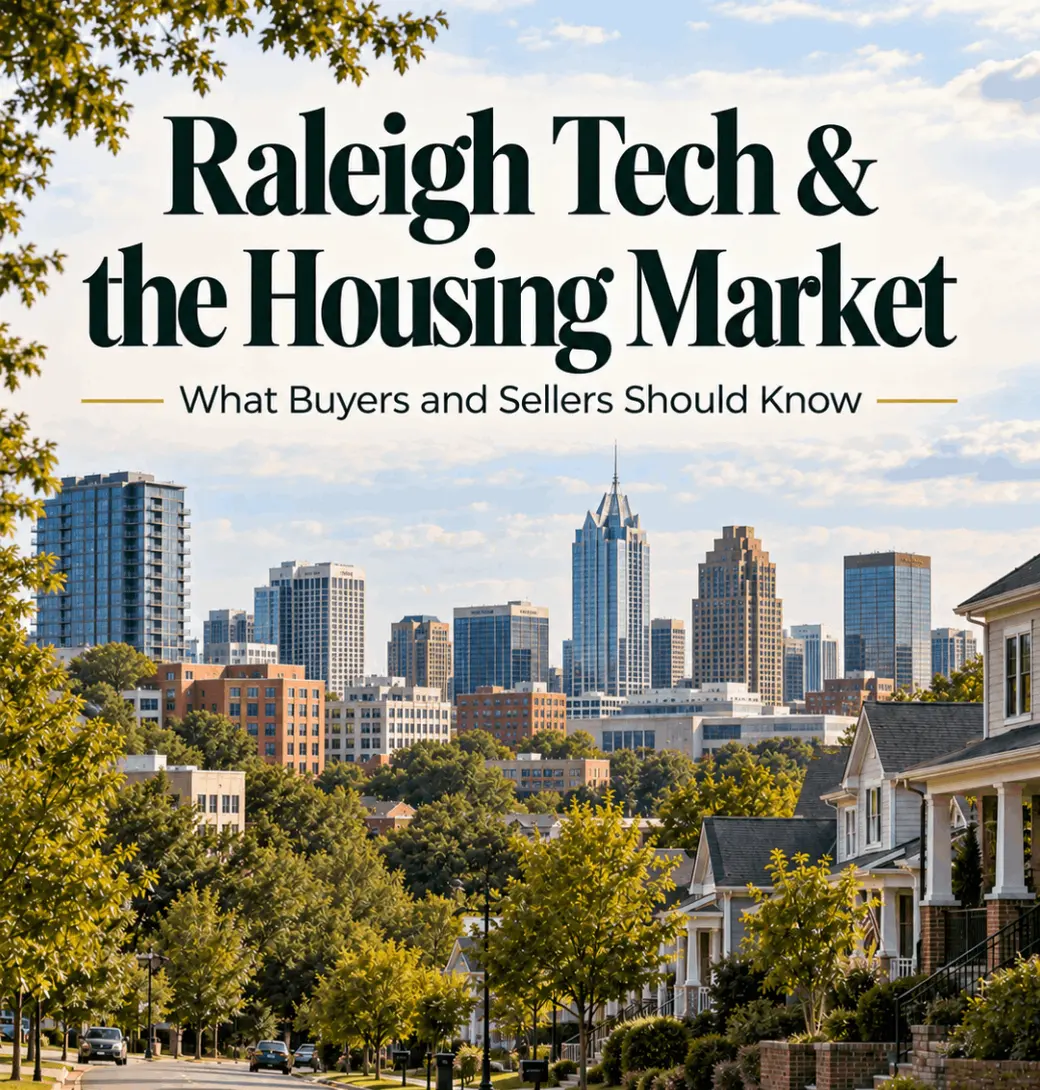
Why Tech and Life Sciences Companies Are Investing in Raleigh, NC and What It Means for the Housing Market
By Tricia Greene | Broker & Founder, Greene Realty Group, powered by LPT Realty
Raleigh, North Carolina, and the surrounding Research Triangle region continue to attract major technology and life sciences investments because of the area's universities, skilled workforce, research infrastructure, and business environment.
Companies including Apple, Google, FUJIFILM Biotechnologies, and Novo Nordisk have announced significant investments across the region. These projects could influence employment, housing demand, transportation, and residential development for years to come.
But here's something I always encourage buyers and homeowners to understand: A major corporate announcement does not automatically mean home prices will rise.
The real estate impact depends on where jobs are created, when employees are hired, how much housing is available, and what buyers can afford.
Understanding those connections is far more useful than simply following headlines about billion-dollar investments.
Why Are Major Companies Choosing Raleigh and Research Triangle Park?
The Triangle has several advantages that make it attractive to employers.
1. Access to three major research universities
The region is anchored by:
-
North Carolina State University
-
Duke University
-
University of North Carolina at Chapel Hill
These universities support research, engineering, healthcare, biotechnology, business, and technology education.
For employers, access to skilled workers matters because recruiting and retaining employees is a major part of long-term operating costs.
For the housing market, a steady talent pipeline can help support residential demand, although graduates do not necessarily remain in the area or become homeowners immediately.
2. An established business and research ecosystem
Research Triangle Park (RTP) was established in 1959 and has developed into one of the country's best-known research and technology employment centers.
Located between Raleigh, Durham, and Chapel Hill, RTP provides access to universities, Raleigh-Durham International Airport, and surrounding residential communities.


That geographic spread matters when evaluating housing demand.
3. North Carolina's business tax environment
North Carolina has adopted legislation reducing its corporate income tax rate over time.
However, corporate income taxes are only one part of a company's location decision. Employers also evaluate workforce availability, infrastructure, incentives, real estate costs, utilities, and access to suppliers.
For homeowners, the lesson is straightforward: favorable business conditions can support investment, but they do not guarantee higher property values.
According to the North Carolina Department of Revenue, the corporate income tax rate is 2% for 2026, with the current statutory schedule reaching 0% for tax years beginning after 2029. That does not eliminate every tax or operating expense a corporation may face.
Which Major Companies Are Investing in the Triangle?
Not every investment announcement is at the same stage. Some projects involve established operations, while others involve planned facilities, construction schedules, or hiring commitments spread across several years.
That distinction matters when evaluating potential effects on the local housing market.
Apple: A major planned technology campus in RTP
Apple announced plans in 2021 to invest more than $1 billion in North Carolina, including a new campus in Research Triangle Park and a commitment to create at least 3,000 jobs.
The announcement positioned the Triangle as an important potential location for Apple's engineering and technology operations.
However, the campus project has experienced timeline changes.
For buyers considering a home near RTP, I would not recommend making a purchase based solely on when Apple's campus might be completed.
Instead, consider the employment opportunities that already exist, the property's current market value, and whether the location meets your needs today.
Google: Expanding the Triangle's technology presence
Google announced plans to establish an engineering hub in Durham focused on Google Cloud.
This investment highlighted the region's appeal to technology companies looking for engineering talent outside traditional West Coast markets.
Google's presence also demonstrates an important geographic distinction: not every major Triangle employer is located inside RTP.
Downtown Durham, Raleigh, Cary, and Morrisville all play different roles in the region's employment landscape.
FUJIFILM: A major life sciences investment in Holly Springs


FUJIFILM announced an additional $1.2 billion investment in April 2024, bringing the total announced investment in its Holly Springs biomanufacturing facility to more than $3.2 billion.
The company stated that its expansion plans would bring total projected new local employment to approximately 1,400 jobs by 2031.
Biomanufacturing involves producing biological medicines or materials using living cells and specialized manufacturing processes.
These facilities require a mix of scientists, engineers, manufacturing technicians, quality-control professionals, and supporting personnel.
What this means for Holly Springs homeowners: A growing employment center may increase interest in nearby neighborhoods, but its effect on home values will depend on actual hiring, available housing, financing conditions, and competing developments.
Novo Nordisk: Major manufacturing investment in Clayton
Novo Nordisk has announced a multibillion-dollar manufacturing expansion in Clayton, located in Johnston County.
Clayton is outside Wake County, but the investment is still relevant to the broader Triangle housing market.
Employees may consider homes in Clayton, Garner, Fuquay-Varina, southeastern Raleigh, and other communities depending on their work location and commuting preferences.
This is why I encourage buyers to evaluate the entire employment corridor rather than assuming every incoming worker will want to live near RTP.
How Corporate Expansion Can Affect Raleigh-Area Home Prices
A growing employment base can support housing demand, but the relationship is not automatic.
There are several steps between a corporate announcement and a change in neighborhood home prices.
HOW ECONOMIC GROWTH MAY INFLUENCE HOUSING
Corporate investment
A company announces or begins a project
Hiring and relocation
Jobs are filled and some workers move to the area
Housing demand
Workers choose whether and where to rent or buy
Local market response
Prices, inventory, and competition may change
1. Employment growth can create new housing demand
When employers hire workers who relocate to the Triangle, some will purchase homes.
Others may rent, live with family, or commute from communities outside the immediate employment area.
A projected job is not automatically a new homebuyer.
2. Housing inventory determines how demand affects prices
Housing inventory refers to the number of homes available for sale.
If demand increases faster than the number of available homes, buyers may face greater competition.
If builders deliver additional homes or more existing homeowners decide to sell, the market may absorb new demand without significant price increases.
3. Mortgage rates influence purchasing power
Even a buyer with a strong salary may have limits on what they can comfortably afford.
Higher mortgage rates increase monthly payments and can reduce purchasing power.
This is one reason economic growth and rising home prices do not always occur at the same time.
4. Location matters more than regional headlines
Two neighborhoods within the same town can perform differently.
School assignments, property condition, lot size, neighborhood amenities, competing listings, and access to employment centers all influence buyer demand.
As a broker, I would rather examine comparable home sales in a specific neighborhood than rely on a broad prediction about the Triangle's economy.
Where Are Buyers Looking Around Research Triangle Park?
The Triangle offers a variety of communities, each with different housing styles, price points, and transportation considerations.
There is no single best suburb for everyone.
The better question is which location offers the right combination of affordability, lifestyle, commute, and long-term flexibility.
Regional community comparison qualitative guidance, not a ranking or live pricing report.
|
Community |
Location advantage |
What buyers should consider |
|---|---|---|
|
Cary |
Established neighborhoods and access to RTP and RDU |
Prices vary widely by neighborhood and property type |
|
Apex |
Historic downtown and southwest Wake County access |
Compare newer developments with established communities |
|
Morrisville |
Close to many RTP employers and RDU |
Housing density, traffic, and property type |
|
Holly Springs |
Southern Wake County and life sciences employment |
Construction growth and commuting routes |
|
Raleigh |
Urban, suburban, and established residential options |
Significant differences between neighborhoods |
|
Durham |
University, medical, and technology employment |
Neighborhood-specific pricing and travel routes |
|
Wake Forest |
Northern Wake County lifestyle and housing options |
Commutes to RTP can be longer |
|
Fuquay-Varina |
Southern Wake County and new construction |
Road access and infrastructure growth |
|
Wendell |
Eastern Wake County and expanding residential development |
Distance to western Triangle employers |
|
Knightdale |
Eastern Raleigh access and I-540 connections |
Traffic patterns and neighborhood development |
Cary and Morrisville: Established options near RTP


Cary and Morrisville are worth considering for buyers whose employment is concentrated around RTP, RDU, or western Wake County.
Cary offers a mix of established neighborhoods, parks, greenways, townhomes, and single-family homes.
Morrisville provides access to major employment corridors and a range of residential communities.
Neither location should be evaluated using a single advertised commute time. The exact workplace address and neighborhood entrance can make a substantial difference.
Apex and Holly Springs: Southwest Wake County


Apex offers a historic downtown, established neighborhoods, and newer residential developments.
Holly Springs has attracted residential growth alongside expanding life sciences activity.
For buyers considering either community, I recommend comparing existing homes and new construction carefully.
Builder incentives, homeowners association fees, property taxes, and the number of competing new homes can affect the true cost of ownership.
Raleigh and Durham: Urban and suburban choices


Raleigh and Durham provide alternatives for buyers who want access to established employment centers, restaurants, cultural amenities, and different housing styles.
Downtown living and suburban living can involve very different trade-offs, even within the same city.
Condominium association dues, parking, maintenance costs, and property age are especially important when comparing urban properties with suburban single-family homes.
Wendell, Knightdale, and Eastern Wake County


Eastern Wake County deserves attention from buyers who want to compare housing options outside the more established western Triangle markets.
Wendell and Knightdale offer access to eastern Raleigh, growing residential communities, and regional highways.
However, I would caution buyers against assuming that planned highway projects will automatically produce shorter commutes or higher home values.
Infrastructure improvements can increase accessibility, but their impact depends on the final road design, traffic volumes, completion dates, and future development.
Fuquay-Varina and Wake Forest: Additional options to compare
Fuquay-Varina and Wake Forest are also worth including in a broader Triangle home search.
Both offer a mix of established neighborhoods and newer construction, but their locations create different commuting considerations.
A buyer working in Clayton may prioritize a different set of communities than someone traveling daily to RTP.
The right search strategy begins with the actual work location, not simply the town with the most publicity.
How Will I-540 Affect Growth in Eastern Wake County?
Transportation infrastructure is another important part of the Triangle's growth story.
The Complete 540 project is designed to finish the outer highway loop around Raleigh, connecting communities across southern and eastern Wake County.
According to the North Carolina Department of Transportation, Phase 1 opened in September 2024. Phase 2, extending toward Knightdale, is scheduled to open in late 2028.
For buyers considering Wendell, Knightdale, Garner, Clayton, or Fuquay-Varina, the project may create additional travel options.
But I would not assume a specific reduction in commute time until the roadway is operating and actual traffic patterns can be evaluated.
A home should make financial and practical sense based on today's conditions, with future improvements treated as potential benefits rather than guarantees.
Is Raleigh Still More Affordable Than California's Technology Markets?
Raleigh and the surrounding Triangle communities can offer different housing options and cost structures than high-priced California markets, including Silicon Valley.
However, comparing the average home price in San Jose with the median home price in Wake County does not produce a reliable apples-to-apples affordability comparison.
Buyers should consider:
-
Home price: Compare similar properties, not a condominium in one market with a detached home in another.
-
Property taxes: Evaluate the specific property and local tax jurisdiction.
-
Insurance: Obtain actual homeowners insurance estimates.
-
Income: Consider whether compensation changes when relocating.
-
Transportation: Include commuting costs, tolls, and vehicle expenses.
-
Monthly housing payment: Compare principal, interest, taxes, insurance, and association fees.
A lower purchase price does not automatically mean a lower overall cost of living.
For relocation buyers, I recommend evaluating the complete household budget rather than relying on a national cost-of-living ranking.
What Should Raleigh-Area Homeowners Do With This Information?
If you already own a home in Raleigh, Cary, Apex, Holly Springs, Wake Forest, Wendell, or another Triangle community, major employment announcements are worth following.
But they should not be the primary basis for deciding when to sell.
Instead, I recommend focusing on three questions.
1. What are comparable homes actually selling for?
A comparative market analysis, or CMA, evaluates recently sold properties and current competition to estimate a home's likely market position.
It is more useful than applying a regional appreciation prediction to every property.
2. How much competition would your home face?
An expanding regional economy does not eliminate competition from other sellers.
If several similar homes are listed in your neighborhood, buyers may have more negotiating power.
3. Does selling support your personal goals?
Your financial position, next housing plans, mortgage rate, and timing may matter more than whether a major company is expanding nearby.
The strongest selling strategy begins with your circumstances, not a headline.
What Should Relocation Buyers Know Before Purchasing in the Triangle?
Relocating for a new position at RTP, a biotechnology company, a university, or another regional employer involves more than finding a house near the office.
I recommend the following process.
-
Confirm your actual workplace location. RTP, downtown Durham, downtown Raleigh, Holly Springs, and Clayton are different employment destinations.
-
Establish a comfortable monthly payment. Include taxes, insurance, association dues, and potential maintenance.
-
Compare multiple communities. Do not eliminate an area simply because it is less familiar.
-
Test your commute. Evaluate routes during the hours you expect to travel.
-
Review the neighborhood's resale competition. Consider nearby new construction and comparable existing homes.
-
Investigate future development. Review municipal plans and approved projects while recognizing that plans can change.
-
Choose a home that works without relying on appreciation. Future price growth should never be the only reason to purchase.
A home can be a good decision because it fits your life and finances, even if its market value does not rise quickly.
Frequently Asked Questions About Raleigh's Corporate Growth and Real Estate Market
Why are technology companies moving to Raleigh, NC?
Raleigh and the Research Triangle attract technology companies through their research universities, skilled workforce, established business infrastructure, and access to regional employment centers. Corporate location decisions also depend on incentives, operating costs, and business needs.
Is Apple still planning a campus in Research Triangle Park?
Apple announced a major RTP campus investment in 2021, including plans for at least 3,000 jobs. The project has experienced timeline changes. Buyers should verify the latest development status rather than assuming that all announced jobs or facilities are already in place.
How much is FUJIFILM investing in Holly Springs?
FUJIFILM announced that its total planned investment in its Holly Springs biomanufacturing facility exceeded $3.2 billion following an additional investment announced in April 2024.
Will new technology jobs increase Raleigh home prices?
Additional jobs can support housing demand, particularly when workers relocate to the region. However, home prices also depend on mortgage rates, affordability, housing supply, and local market conditions. No individual corporate announcement guarantees appreciation.
What are the best suburbs near Research Triangle Park?
Cary, Morrisville, Apex, and parts of Durham and Raleigh are common areas to compare when working near RTP. The best choice depends on the specific workplace, housing budget, commute preferences, and lifestyle needs.
Is Holly Springs a good place to buy a home?
Holly Springs offers established neighborhoods, newer residential construction, and proximity to growing southern Wake County employment areas. Whether a particular home is a good purchase depends on its price, condition, financing, neighborhood competition, and the buyer's goals.
Is Wendell a good alternative to Cary or Apex?
Wendell may appeal to buyers interested in eastern Wake County, newer communities, and a different mix of housing options. However, its location can create a longer commute to western Triangle employment centers. Buyers should compare total ownership costs and daily travel needs.
Will the completion of I-540 increase home values?
Improved highway connectivity can affect housing demand and development patterns, but appreciation is not guaranteed. Buyers should evaluate current accessibility, neighborhood conditions, and property values rather than purchasing solely because of a planned roadway.
Is 2026 a good time to buy a home in Raleigh?
The right time depends on your financial readiness, available inventory, mortgage options, and expected length of ownership. A neighborhood-specific market analysis is more useful than a broad prediction about whether the entire Raleigh market will rise or fall.
Final Thoughts: Raleigh's Growth Creates Opportunity, but Strategy Still Matters
Raleigh and the Research Triangle have developed an economic foundation supported by technology, life sciences, healthcare, higher education, and other industries.
Major corporate investments reinforce the region's economic importance, but their impact on housing will vary across communities and over time.
For buyers, that means looking beyond company announcements to understand neighborhoods, commuting patterns, housing inventory, and the true cost of ownership.
For homeowners, it means evaluating what buyers are paying for comparable properties today rather than assuming regional growth guarantees future appreciation.
The goal is not to predict the next neighborhood to become popular. It is to make a real estate decision based on reliable information, sound financial planning, and your long-term needs.
If you're considering buying, selling, or relocating within the Triangle, I can help you evaluate the local market and understand how regional development may affect your options.
Sources and fact-checking references
These are authoritative sources to retain with the published article:
-
Research Triangle Park — RTP 3.0 and Park Information — RTP's founding, size, companies, and employment.
-
North Carolina Department of Revenue — Corporate Tax Rates — current corporate tax information.
-
FUJIFILM — Holly Springs Investment Announcement — investment amounts and projected employment.
-
NC Department of Commerce — Major Investment Announcements — Apple, FUJIFILM, and Novo Nordisk investment commitments.
-
Google — U.S. Investment Announcement — Durham cloud engineering site.
-
NCDOT — Complete 540 Project — highway project details and construction schedule.
Categories
- All Blogs (24)
- Banks 20 Raleigh (1)
- BanksTwenty Raleigh NC (1)
- Bonus Depreciation (1)
- Complete 540 (1)
- Cost Segregation (1)
- first time homebuyer (9)
- FSBO (1)
- home maintenance (2)
- home selling (8)
- homebuying (10)
- Knightdale NC (1)
- Mungo Homes (1)
- Neuse River (1)
- north Carolina (14)
- North Carolina Economic Development (1)
- Raleigh Master Planned Communities (1)
- Raleigh New Homes (1)
- Raleigh Real Estate Market (1)
- Relocation (11)
- Research Triangle Park (1)
- Retirement Savings (2)
- sellers (1)
- Southeast Raleigh New Construction (1)
- Tax Strategy (2)
- Triangle Relocation (1)
- Veridia Apex (1)
- Wake County Real Estate (1)
- Wendell Real Estate (1)
Recent Posts