The Next Frontier: Raleigh's 5 Growth Corridors That Could Shape Home Values Through 2035
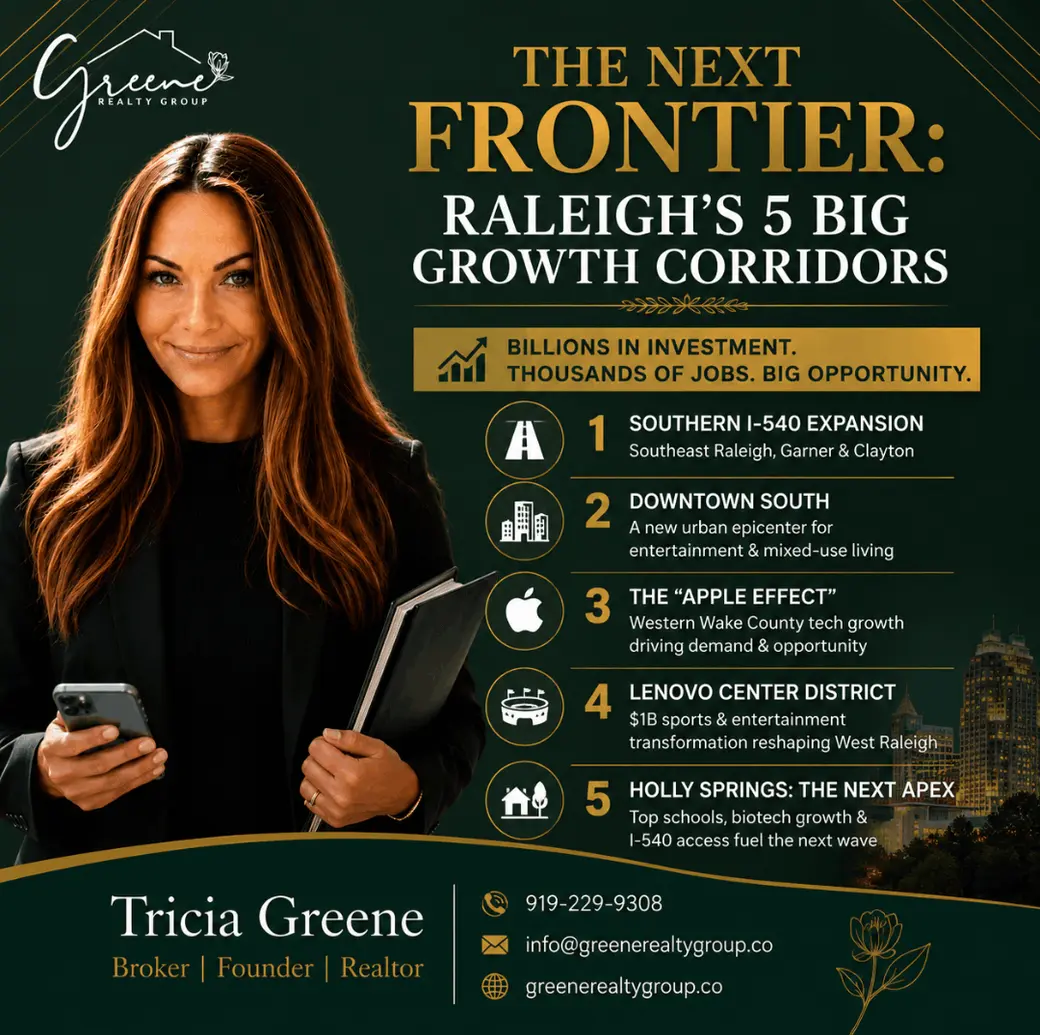
The Next Frontier: Raleigh's Multi-Billion Dollar Growth Corridors
Why the Triangle's Next Decade Could Reshape North Carolina Real Estate
If you're trying to identify where home values could see the greatest long-term growth in the Triangle, follow the infrastructure, jobs, and major private investment not the headlines.
The Raleigh-Durham region is entering what many economists and urban planners would consider a second major growth cycle. Unlike the first wave of expansion, which was fueled primarily by Research Triangle Park (RTP), universities, and population growth, this next phase is being driven by billions of dollars in transportation improvements, corporate investment, biotechnology, mixed-use developments, and entertainment districts.
Historically, when regions experience multiple economic growth drivers simultaneously, nearby housing demand often follows. While no one can guarantee future appreciation, understanding where investment is occurring can help buyers, homeowners, and investors make more informed decisions.
If you're wondering where Raleigh's next growth corridors may emerge, these are five of the most important areas to watch over the coming decade.
Why Infrastructure Creates Real Estate Growth
Infrastructure rarely receives the attention that home prices or mortgage rates do, but it is one of the strongest long-term indicators of future development.
When governments and private companies invest billions of dollars into an area, they aren't simply improving roads or constructing buildings they're changing how people live, work, commute, and spend money.
Major infrastructure projects often lead to:
- Reduced commute times
- Increased business investment
- Higher-paying job creation
- Retail expansion
- Restaurant and entertainment growth
- New residential development
- Increased housing demand
While every project is different, these conditions often create long-term upward pressure on nearby property values.
The Five Triangle Growth Corridors to Watch
1. Southern I-540 Expansion
Southeast Raleigh, Garner, and Clayton
One of the most transformative infrastructure projects in North Carolina is the completion of the Southern Wake Expressway, the final section of Interstate 540.
For decades, many buyers viewed southeast Wake County and neighboring Johnston County communities as less desirable simply because of commute times.
That dynamic is changing.
The expanded interstate creates significantly better access between:
- Raleigh
- Garner
- Clayton
- Research Triangle Park (RTP)
- Cary
- Apex
- Raleigh-Durham International Airport (RDU)
Why this matters
Accessibility is one of the strongest drivers of residential demand.
As commute times decrease, more buyers begin considering areas that previously felt too far away.
Communities like Garner and Clayton still generally offer:
- Larger homes
- Larger lots
- New construction opportunities
- Lower entry prices than many western Wake County communities
For many buyers relocating from higher-cost states, these markets represent greater value while remaining connected to the Triangle's employment centers.
2. Downtown South
Raleigh's Future Mixed-Use Destination
South Raleigh is positioned for one of the region's largest long-term redevelopment opportunities.
The proposed Downtown South development envisions:
- Residential neighborhoods
- Office space
- Retail
- Restaurants
- Entertainment
- Public gathering areas
- Potential sports facilities
Large mixed-use developments often create an economic ripple effect extending well beyond their boundaries.
National examples include:
|
Development |
Market Impact |
|
The Battery (Atlanta) |
Increased nearby residential demand and mixed-use investment |
|
Nashville Gulch |
Significant redevelopment and appreciation |
|
Reston Town Center (Virginia) |
Strong residential and commercial growth |
Why South Raleigh could benefit
Historically, neighborhoods surrounding major redevelopment projects often experience:
- New business investment
- Streetscape improvements
- Increased consumer traffic
- Higher residential demand
- Renovation activity
While timelines and final plans may evolve, South Raleigh remains one of the Triangle's most closely watched redevelopment areas.
3. The Apple Effect
Western Wake County
Apple's announcement that it plans to develop a major engineering campus in Research Triangle Park immediately elevated the Triangle's national profile.
Although construction timelines have shifted, the long-term significance remains substantial.
Large technology employers frequently influence surrounding housing markets because they attract:
- Engineers
- Executives
- Software developers
- Scientists
- Support staff
- Suppliers
- Additional technology companies
Areas likely to benefit
- Cary
- Apex
- Morrisville
- RTP
- Northwest Raleigh
These communities already offer:
- Highly rated public schools
- Established neighborhoods
- Convenient airport access
- Shorter commutes to RTP
- Strong quality-of-life amenities
Why some experts believe a window still exists
Because portions of Apple's campus development have been delayed, some buyers believe housing demand has not yet fully reflected the project's long-term economic impact.
No one knows exactly when future appreciation may occur, but delayed construction has extended the timeline for many buyers considering these markets.
4. The Lenovo Center Sports & Entertainment District
One of Raleigh's most ambitious redevelopment efforts surrounds the Lenovo Center and Carter-Finley Stadium area.
Plans envision transforming what has historically functioned primarily as an event destination into a year-round mixed-use district featuring residential, retail, entertainment, hospitality, and office space.
Potential long-term impacts include:
- Increased walkability
- Expanded nightlife
- New apartments
- Hotels
- Restaurants
- Office development
- Improved public spaces
Areas that may benefit
- Blue Ridge Road corridor
- West Raleigh
- NC State University area
- Edwards Mill Road
- Trinity Road
As land surrounding entertainment districts becomes more desirable, redevelopment opportunities often expand into adjacent neighborhoods.
5. Holly Springs
The Next Major Growth Story?
Every rapidly growing metropolitan region experiences expansion beyond its original core.
Years ago:
- Cary experienced rapid appreciation.
- Apex followed.
- Today, many market observers are watching Holly Springs.
Several factors support continued interest:
Strong employment growth
Biotechnology manufacturing continues expanding throughout southwestern Wake County.
Remaining developable land
Compared with more mature communities, Holly Springs still has opportunities for additional residential development.
Improved transportation
The completion of Interstate 540 improves regional connectivity, reducing travel times across much of Wake County.
Lifestyle appeal
Many relocating buyers are attracted by:
- Newer neighborhoods
- Community amenities
- Parks and greenways
- Strong public schools
- Family-oriented environment
As affordability becomes more challenging in Cary and Apex, some buyers naturally expand their search into Holly Springs.
Comparison: Which Growth Corridor Fits Different Buyers?
|
Area |
Primary Growth Driver |
Buyer Profile |
Potential Advantages |
|
Southeast Raleigh |
Infrastructure |
First-time buyers, investors |
Relative affordability, redevelopment potential |
|
Garner |
I-540 connectivity |
Families, commuters |
Larger lots, improving access |
|
Clayton |
Highway expansion |
Relocating buyers |
More space, value pricing |
|
South Raleigh |
Mixed-use redevelopment |
Investors, long-term homeowners |
Urban revitalization |
|
Cary |
Technology |
Executives, professionals |
Established market, strong amenities |
|
Apex |
Technology + schools |
Families |
Continued demand, excellent schools |
|
Morrisville |
RTP employment |
Technology workforce |
Central location |
|
Holly Springs |
Biotech + growth |
Families, relocations |
New construction, expanding amenities |
|
West Raleigh |
Entertainment district |
Professionals |
Future mixed-use development |
Understanding Key Real Estate Terms
Appreciation
Appreciation is an increase in a property's market value over time. It may result from increased demand, limited housing supply, local economic growth, or infrastructure improvements.
Mixed-Use Development
A mixed-use development combines residential housing with retail, restaurants, offices, entertainment, and public spaces in one area.
Growth Corridor
A growth corridor is a geographic area experiencing concentrated public and private investment that may encourage future residential and commercial development.
Infrastructure Investment
Infrastructure investment includes projects such as highways, utilities, transit systems, bridges, parks, and public facilities that improve how people and businesses function within a region.
Why Corporate Investment Matters
Large employers influence housing markets beyond the jobs they directly create.
Corporate expansion often increases demand for:
- Housing
- Retail
- Healthcare
- Schools
- Restaurants
- Professional services
This secondary economic activity can create additional residential demand across surrounding communities.
How Buyers Can Evaluate Growth Areas
Instead of chasing today's hottest neighborhood, consider asking:
- Are major employers investing nearby?
- Is transportation improving?
- Are population trends increasing?
- Are schools, parks, and amenities expanding?
- Is private development following public investment?
- Are builders purchasing additional land?
- Is the area becoming more connected to employment centers?
Looking at these fundamentals may provide a more complete picture than focusing on recent home prices alone.
Frequently Asked Questions
Which part of Raleigh is expected to grow the fastest?
No one can predict future appreciation with certainty. However, areas receiving significant infrastructure improvements, corporate investment, and mixed-use redevelopment are often watched closely by market analysts.
Will the completion of I-540 affect home values?
Improved transportation can increase buyer demand by reducing commute times and improving regional accessibility. While appreciation is never guaranteed, transportation projects have historically influenced housing markets in many metropolitan areas.
Why is Holly Springs growing so quickly?
Several factors contribute to Holly Springs' growth, including biotechnology expansion, newer housing, quality-of-life amenities, remaining land for development, and improved highway connectivity.
Does Apple's RTP campus still matter?
Yes. Although construction timelines have shifted, Apple's long-term commitment continues to reinforce the Triangle's reputation as a major technology hub.
Is South Raleigh becoming a better investment area?
South Raleigh has attracted increasing attention due to planned redevelopment and infrastructure improvements. As with any investment, buyers should evaluate location, budget, market conditions, and long-term goals.
Should buyers purchase based only on future development?
No. Future projects can influence markets, but buying decisions should also consider affordability, financial goals, lifestyle, commute, schools, and personal circumstances.
Actionable Takeaways
If you're evaluating where to buy or invest in the Triangle, consider these steps:
- Research areas with ongoing public infrastructure projects.
- Track announcements from major employers and economic development organizations.
- Compare current home prices across nearby communities.
- Evaluate commute times to major employment centers such as RTP, Downtown Raleigh, and Durham.
- Look beyond today's market and consider how planned development could influence long-term desirability.
- Work with current market data rather than relying solely on headlines or speculation.
Final Thoughts
The Triangle's next decade of growth appears to be shaped by a convergence of transportation improvements, technology investment, biotechnology expansion, and large-scale mixed-use redevelopment. While no one can guarantee which community will appreciate the most, understanding where infrastructure and economic investment are occurring can help buyers and homeowners make more informed decisions.
Rather than asking, "Where are prices rising today?" a better question may be, "Where are the long-term fundamentals improving?" Those fundamentals, jobs, connectivity, amenities, and sustained investment often provide the clearest picture of where demand may continue to grow.
If you're considering buying, selling, relocating, or investing in Raleigh, Cary, Apex, Holly Springs, Fuquay-Varina, Wake Forest, Durham, Chapel Hill, RTP, or anywhere in the Triangle, take the time to evaluate both today's market conditions and tomorrow's development plans. An informed strategy is almost always more valuable than trying to time the market perfectly.
Categories
Recent Posts